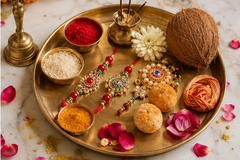
Raksha Bandhan has never been just about tying a thread on a brother's wrist. For many of us, it brings back memories of walking through busy markets, looking at rows of colourful rakhis, and taking forever to choose the one that felt perfect. Today, the choices are even wider. Different types of rakhi are available for every age, tradition and personal style.
Elements like simple sacred threads and beautifully crafted designer pieces are brought together, and thus, the celebration feels a bit more special. In this guide, we will learn more about the varieties and their associated significance:
What Does a Rakhi Symbolise and Why Are There So Many Different Types?
Different types of rakhi may look different. However, they all represent the same bond of love, care and lifelong protection between siblings.
- A rakhi is representative of love and heartfelt prayers for a brother's happiness and well-being.
- Also, family traditions all over India have given rise to so many unique rakhi styles.
- Religious beliefs have inspired several spiritual and sacred designs.
- There are also special rakhis for children, sisters-in-law and even, in some cases, personalised gifting.
What Are the Traditional Different Types of Rakhi?
Traditional types of rakhi are still loved because they keep the customs and spirit of Raksha Bandhan alive.
- Many families continue to tie a Mauli Rakhi, made with the sacred red and yellow thread, as a symbol of blessings, protection, and good fortune.
- A Rudraksha Rakhi often feels like the natural choice for those who want to include a spiritual touch in the celebration due to its association with Lord Shiva.
- Not everyone looks for colourful or elaborate designs. For many, the elegance of a Silver Rakhi says enough and conveys warm wishes for prosperity and happiness.
- The subtle fragrance of Sandalwood Rakhi gives it a charm of its own, and that is one reason it continues to be part of many traditional celebrations.
Which Designer Rakhi Designs Are Popular Today?
Festive shopping looks quite different now. Along with traditional threads, different types of rakhi design have become more detailed, colourful, and creative.
- One glance at a Kundan Rakhi is usually enough to understand why it remains so popular. The stone detailing gives it a festive richness that works for almost every celebration.
- Bright colours have always been part of the appeal of a Meenakari Rakhi. Its enamel work exhibits a traditional art form that still feels alive today.
- Detailed thread embroidery gives the Zardosi Rakhi a handcrafted feel. Metallic accents only enhance the festive character.
- Some rakhis do not rely on bold colours or heavy embellishments. The Pearl Rakhi shows that a simple design can still leave a lasting impression as well.
Which Spiritual and Deity Rakhis Carry Religious Significance?
For many families, Raksha Bandhan is also a time to seek blessings. This is why deity-inspired and spiritual rakhis continue to be chosen alongside decorative designs.
- Many people choose the Om Rakhi because it represents peace, purity and positive energy.
- Homes where Lord Ganesha is worshipped during the festival often include a Ganesha Rakhi as well. Moreover, it is perceived as a symbol of wisdom, success and fresh beginnings.
- The Krishna Rakhi is inspired by Lord Krishna's teachings of love, compassion and guidance. Hence, they have become an ideal choice for families that have a strong devotional connection.
- Throughout generations, the Swastika Rakhi has remained part of festive traditions. It is often regarded as a symbol of prosperity, well-being and good fortune.
What Is a Lumba Rakhi and Why Is It Tied to a Sister-in-Law?
A Lumba Rakhi follows a tradition that has been part of many Marwari and Rajasthani households for years. Along with tying a rakhi to her brother, a sister also ties a decorative Lumba Rakhi to her sister-in-law's wrist or bangle as a way of celebrating her place in the family.
- The tradition recognises the relationship with both the brother and sister-in-law, rather than only one sibling.
- Beads, tassels, pearls and colourful embellishments are generally used to decorate a Lumba Rakhi.
- Unlike a regular rakhi, it is usually tied to a bangle rather than on the wrist.
- Matching Rakhi and Lumba Rakhi sets have become a popular choice for families who enjoy celebrating the couple together.
What Are Evil Eye and Other Auspicious Rakhi Designs?
Some rakhi designs are appreciated since they are believed to bring blessings, protection or good fortune. Thus, the Evil Eye Rakhi has a blue charm that many believe helps protect against negative energy.
- Turtle Rakhi.
- Swastika Rakhi.
- Om Rakhi.
- Ganesha Rakhi.
- Rudraksha Rakhi.
- Sai Baba Rakhi.
- Kalava (Mauli) Rakhi.
Which Rakhi Designs Are Best for Kids?
Children do not look at a rakhi the same way adults do. Bright colours, fun characters and little surprises usually catch their attention first. Hence, different types of rakhi designs for kids are made to be fun as well as festive.
| Kids' Rakhi Design | Why Children Like It |
|---|---|
| Cartoon Rakhi | Has favourite cartoon and superhero characters. |
| Toy Rakhi | Includes small toys or spinning elements for added fun. |
| LED Rakhi | Lights up and makes the rakhi more exciting for children. |
| Musical Rakhi | Plays a tune or sound when some buttons are pressed. |
| Animal-Themed Rakhi | Decorated with cute animals like pandas or elephants. |
| Name Rakhi | Personalised with the child's name for a special touch. |
Conclusion
By the time Raksha Bandhan arrives, choosing a rakhi is often one of the most enjoyable parts of the festival. Some people never move beyond a simple sacred thread, while others spend time finding a design that represents a brother's personality. With so many different types of rakhi to choose from, there is something for every tradition, every age, and every relationship. In the end, the thread is only a symbol. The love behind it is what stays.