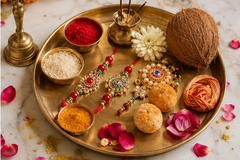
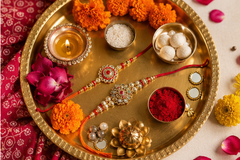
Rakhi season brings out more than just colourful threads and sweet boxes. It brings out a whole family of traditions that most people outside Rajasthan have barely heard of. While there are numerous types and varieties of Rakhis available, a major curiosity about what is Lumba Rakhi exists among people. We have the answer, right here.
If you have spotted a dangling and tassel-heavy rakhi meant for a sister-in-law's bangle instead of a brother's wrist, you already know about this Rakhi.
For all those who know about this Rakhi, and those getting introduced to it for the first time, this blog will be a complete guide. We have discussed the meaning, ritual and designs associated with it so you understand exactly why this thread carries so much weight in North Indian traditions.
What Is Lumba Rakhi?
The Lumba rakhi meaning is a decorative thread tied specifically to a sister-in-law's wrist bangle rather than a brother's wrist. It usually comes with beads, tassels and a bold and festive look built to sit against a bangle rather than skin.
Unlike the standard rakhi exchanged between siblings, this one celebrates the bond a woman shares with her husband's sister, turning Raksha Bandhan into a two-way family celebration instead of a single exchange.
The Origin of Lumba Rakhi in Rajasthani and Marwari Tradition
Lumba Rakhi traces back to Rajasthan, where Marwari families have long treated Raksha Bandhan as a festival for the whole household, not just one relationship. According to their traditions, when a woman marries into a family, she embraces quite a few new relationships: a wife, a daughter-in-law, and also a sister-in-law.
It is here that she is welcomed as a sister by her nanad (husband’s sister), and the Lumba Rakhi is tied to reflect that symbol of acceptance and warmth for the new bride. What began as a regional custom in Rajasthani havelis has now travelled across the world, adopted by families who want their festivities to feel a little more inclusive and a little more generous with affection.
Why Is Lumba Rakhi Tied?
The Bhabhi Rakhi meaning goes beyond decoration. It is tied to honour the woman who joined the family through marriage and now shares in its joys, responsibilities and celebrations. Some of the reasons a Lumba Rakhi is tied include:
- Welcoming the bhabhi as a true sister by her nanad.
- Strengthening the emotional bond between the husband's sister and his wife.
- Acknowledges that family ties extend beyond blood relations.
For many households, this exchange softens the early awkwardness a new bride might feel. A Lumba Rakhi gives the bride a sense of belonging. Families who follow this custom often describe it as one of the warmest parts of Raksha Bandhan, since it turns the festival for siblings into a full family affair where every woman in the house has a role and a reason to celebrate.
How a Lumba Rakhi Is Tied on the Bangle
Tying a Lumba Rakhi follows a rhythm close to the traditional rakhi ceremony, with one key difference in placement.
- The nanad prepares a thali with tilak, rice grains, a diya and sweets.
- She applies tilak on her bhabhi's forehead as a mark of respect.
- The Lumba Rakhi is looped around the bangle instead of the wrist itself.
- Sweets are offered, and gifts often follow.
Because it hangs from a bangle, the rakhi shows off its tassels and beadwork with every hand movement, turning it into a symbol of the sacred ritual and a piece of jewellery worn with pride through the day.
Cultural and Spiritual Significance of Lumba Rakhi
A Lumba Rakhi is more than a thoughtful gesture. It carries a quiet meaning rooted in love, respect and family traditions. In many Marwari households, tying a Lumba Rakhi to the bhabhi is a way of wishing her happiness, good health and protection.
A woman may become part of the family through marriage. But the Lumba Rakhi is one of the traditions that makes her feel truly included. Instead of quietly accepting her role, the family takes a moment to recognise it. For many Rajasthani families, love is not something that stays unspoken. It is shown through small gestures that are repeated year after year. Every Raksha Bandhan, a new Lumba Rakhi carries that same feeling forward and keeps the tradition and the relationships equally meaningful.
Popular Lumba Rakhi Designs to Choose From
Modern Lumba Rakhis have transformed to a great extent. From simple thread and beads to Kundan designs, these Rakhis have come a long way, giving buyers plenty of choice depending on taste and budget.
- Kundan and stone-studded designs for a traditional and regal look.
- Pearl-tasselled rakhis for understated elegance.
- Meenakari-work rakhis inspired by classic Rajasthani jewellery.
- Silk-thread rakhis with pom-poms for a festive and colourful finish.
- Silver or gold-plated Lumba Rakhis for families who prefer a luxe touch.
Each style lets a nanad pick something that reflects her bhabhi's personality, whether that means bold and traditional or light and contemporary.
Conclusion
The Lumba Rakhi is proof that Raksha Bandhan is not just a ritual that celebrates the bond within brothers and sisters. It’s more than that. Rooted in Rajasthani and Marwari tradition, this bangle-tied thread embraces the sisterly bond between a new bride and her sister-in-law, thus giving her a rightful place in the family, customs, and lives of all the family members.
Every Lumba Rakhi carries a message that is built on love and is chosen with just as much love as is inherited. If you wish to celebrate the unique bond with your bhabhi, consider buying designer rakhis along with sweets from Gayatri Store.